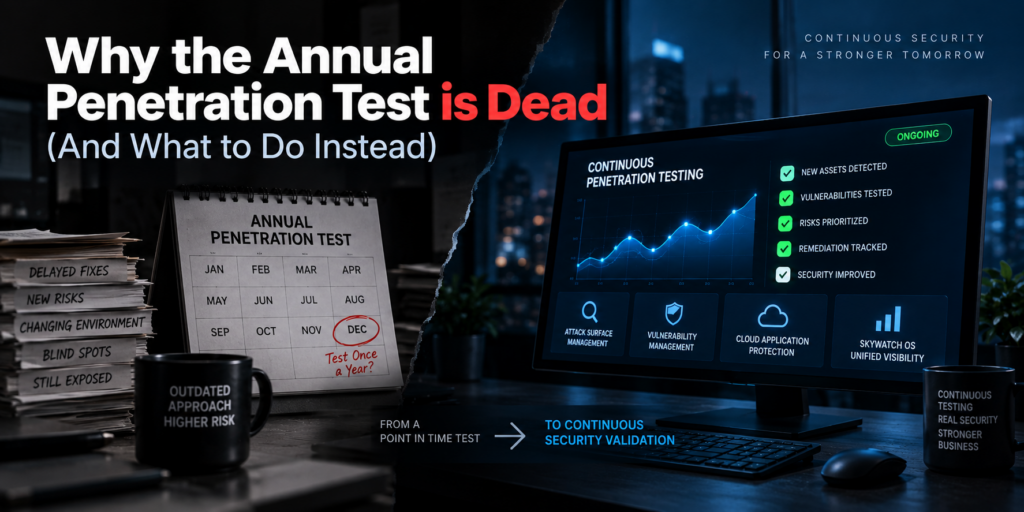
An annual penetration test can tell you a lot about your security. But it only tells you what was exposed and exploitable at the time of the test.
That is the main problem.
Your applications change. New APIs go live. Cloud resources are added. Software is updated. Employees change roles. New vulnerabilities are disclosed. Attackers also change their methods.
A security test done once a year cannot keep pace with these changes.
This does not mean annual penetration testing has no value. It still plays an important role in compliance, major system assessments, and deep manual testing. The issue is relying on it as your main security validation method.
Modern businesses need continuous penetration testing and regular security validation to reduce the gaps between tests.
Why Annual Penetration Testing Made Sense Before
For many years, businesses worked with more stable IT environments.
Applications changed less often. Most systems were hosted inside company data centers. Releases were slower. Infrastructure had clearer boundaries.
An annual penetration test made more sense in that environment.
A security team could test the network, applications, servers, and other important systems once or twice a year. The report would then provide a list of vulnerabilities and security weaknesses that needed attention.
The problem is that modern environments no longer stay still.
Cloud services can be created within minutes. Development teams can release new application versions every week or even every day. APIs connect internal systems with external platforms. SaaS tools add new access points. Remote users connect from different locations and devices.
The environment tested in January may look very different by December.
The Problem With a Point in Time Security Test
A penetration test is a snapshot.
It shows what an attacker could do during a defined testing period. That snapshot is useful, but it has a clear limit.
Imagine that your security team completes a penetration test in January.
The report shows 15 vulnerabilities. Your team fixes all 15.
In March, a new API was deployed.
In April, a cloud server was added.
In May, a software update introduced a new weakness.
In June, a third party gets access to an internal system.
None of these changes were part of the January test.
Your old penetration test can still be accurate. It simply no longer represents the complete security state of the business.
This creates a security gap between what was tested and what exists now.
Your Environment Changes the Day After the Test
Security does not stop when a penetration test ends.
A new application release can change the attack path. A configuration change can expose a service. A new API endpoint can create another route to sensitive data.
Even a small change can have a security impact.
This is why security teams need continuous security testing instead of depending only on a fixed testing date.
Continuous penetration testing keeps testing closer to the pace of change. It can repeatedly assess systems and applications so that security teams do not have to wait months before a new weakness is tested.
At GLESEC, our Continuous Penetration Testing approach is designed around this idea. Testing continues as the environment changes, helping security teams identify weaknesses before they remain hidden for long periods.
New Vulnerabilities Can Appear Between Tests
There is another major problem with annual testing.
New vulnerabilities do not wait for your next scheduled penetration test.
A vulnerability may be disclosed months after your last assessment. If the affected software exists in your environment, your risk can change immediately.
Traditional vulnerability scanning can help identify known weaknesses. But scanning alone does not always show whether a vulnerability can actually be exploited or how an attacker could use it.
Penetration testing adds that validation layer.
The goal is not simply to create another list of CVEs. The goal is to understand real attack paths, validate weaknesses, and determine what could happen if an attacker successfully exploited them.
Continuous security testing helps bring that validation closer to the point when changes and new risks appear.
Cloud and APIs Make the Gap Even Bigger
Cloud environments have made the old annual testing model harder to maintain.
A business may have workloads across several cloud services, multiple applications, remote access systems, containers, databases, and third party integrations.
APIs add another layer.
Every exposed API can become part of the attack surface. Some APIs may be documented. Others may be forgotten, changed, or created without the security team having complete visibility.
This is where Attack Surface Management becomes important.
Attack Surface Management helps organizations maintain visibility into internet facing assets, domains, applications, APIs, services, and other externally exposed infrastructure.
Without that visibility, a penetration test may focus on the assets the security team already knows about while an overlooked asset remains outside the testing scope.
Finding a Vulnerability Is Not the Same as Fixing It
Another common problem is the gap between security findings and remediation.
A penetration test can identify a serious vulnerability. But the vulnerability still exists until someone fixes it.
Security teams often have hundreds or thousands of findings from scanners, penetration tests, cloud tools, endpoint systems, and other security products.
Not every finding has the same level of risk.
A critical vulnerability on an exposed production system may require immediate action. A low risk issue on an isolated internal asset may not.
This is why vulnerability management needs to be connected to security testing.
Continuous vulnerability management helps security teams prioritize findings based on risk and track them through remediation.
The goal should not be to produce more security findings.
The goal should be to reduce real security risk.
What Continuous Penetration Testing Actually Means
Continuous penetration testing does not mean a penetration tester is manually attacking your environment every second of every day.
It means security testing becomes an ongoing process instead of a single annual event.
The testing program can repeatedly assess applications, networks, cloud environments, APIs, and other defined assets. Testing routines can also adapt as the environment and threat landscape change.
Human expertise remains important.
Automated testing can provide scale and frequency, while security professionals can validate findings, assess attack paths, remove false positives, and provide context around the risks.
This combination gives security teams something an annual report cannot provide: a more current view of security exposure.
Continuous Testing vs Annual Penetration Testing
Annual penetration testing and continuous penetration testing do not have to compete.
They serve different purposes.
An annual or periodic penetration test can provide a deep assessment of a specific environment. It can also support compliance requirements and provide an independent review.
Continuous testing adds another layer by checking for security weaknesses more frequently.
The difference is simple.
Annual testing asks:
“What could an attacker exploit when we tested the environment?”
Continuous testing asks:
“What could an attacker exploit as our environment continues to change?”
That second question is becoming more important for modern businesses.
Attack Surface Management Fills the Visibility Gap
You cannot test what you cannot see.
An organization may know its main website and production applications but have less visibility into forgotten subdomains, exposed services, old infrastructure, development assets, or third party connected systems.
Attack Surface Management helps create a broader view of external exposure.
It can identify assets that need monitoring and help security teams understand where new exposure appears.
This creates a useful connection between visibility and testing.
Attack Surface Management shows what is exposed.
Penetration testing validates what can be exploited.
Vulnerability management helps prioritize what needs to be fixed.
Together, these processes create a stronger security validation cycle.
How to Build a Continuous Security Validation Program
A practical program does not need to replace every security process at once.
Start with your most important assets.
Identify your internet facing applications, APIs, cloud workloads, critical systems, and sensitive data environments.
Then establish regular security testing for those assets.
Connect the findings to vulnerability management so that issues can be prioritized and tracked. Monitor the external attack surface so new assets do not remain outside the security process.
Cloud Application Protection can add another layer for internet facing applications and APIs by providing protection and ongoing visibility into application level risks.
The important part is the connection between these controls.
Security testing should not operate as an isolated activity. It should feed useful information into the wider security process.
Where SKYWATCH OS Fits
Continuous security creates a large amount of information.
Security teams need to understand what changed, which risks matter most, what has been fixed, and where action is still required.
GLESEC SKYWATCH OS brings security operations into a unified environment. It combines security visibility, risk scoring, monitoring, threat intelligence, and operational workflows to help teams maintain a clearer view of their security posture.
This matters because continuous testing is only useful when security teams can act on the results.
A vulnerability that sits in a report for six months does not reduce risk.
A finding that is prioritized, assigned, remediated, and validated does.
What to Do Instead of Relying on One Annual Pentest
The answer is not to throw away annual penetration testing.
Instead, make it one part of a continuous security validation program.
A stronger approach looks like this:
1. Map the attack surface
Know which applications, APIs, domains, cloud assets, and services are exposed.
2. Test continuously
Use continuous penetration testing to validate security weaknesses as systems change.
3. Prioritize vulnerabilities
Rank findings based on real business and security risk rather than treating every issue equally.
4. Remediate and validate
Fix important vulnerabilities and test again to confirm that the weakness has actually been addressed.
5. Monitor continuously
Track changes in your environment and external attack surface.
6. Keep annual testing where it adds value
Use deeper periodic assessments for compliance, major systems, and areas that require detailed manual testing.
This approach turns penetration testing from an annual event into an ongoing security process.
The Annual Penetration Test Is Not Dead. The Annual-Only Model Is.
Annual penetration testing still has a place in a mature security program.
The problem is treating one test as proof that the environment is secure for the rest of the year.
Modern infrastructure changes too quickly for that assumption.
Applications are updated. APIs are added. Cloud resources appear. New vulnerabilities are disclosed. Attack techniques change.
Security validation needs to keep pace.
Continuous penetration testing, Attack Surface Management, vulnerability management, and ongoing monitoring provide a stronger way to manage this changing environment.
At GLESEC, we bring these capabilities together to help organizations move from periodic security checks toward continuous security validation.
The goal is not simply to test more often.
The goal is to reduce the time between exposure, detection, validation, and remediation.
That is what modern penetration testing should look like.
 NEWS POSTS