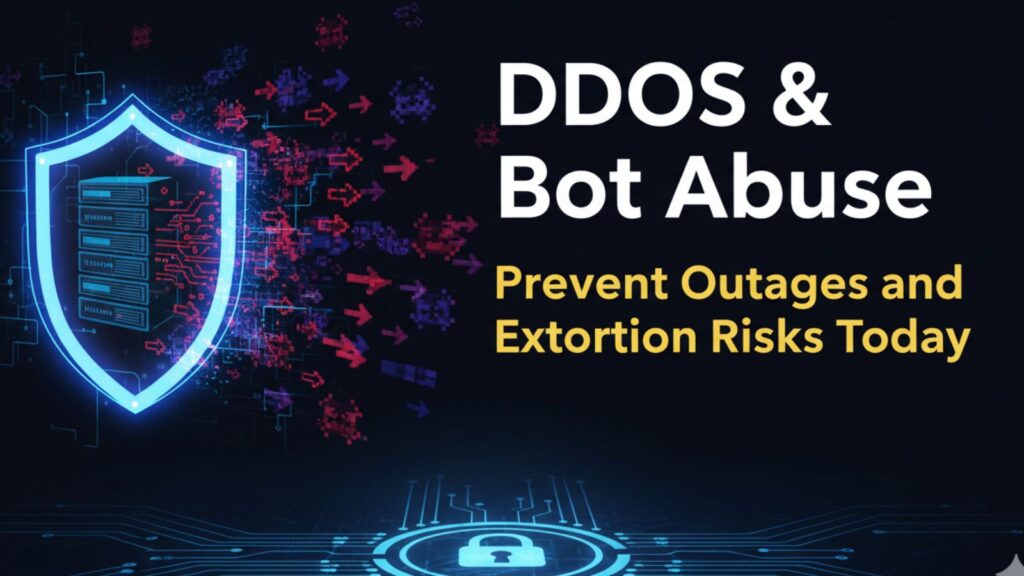
Your website just went dark. Customers can’t log in. Your call center is flooded. Within minutes, an email arrives demanding payment in Bitcoin to stop the attack.
This isn’t a movie scenario. It’s happening to healthcare providers and credit unions across America right now. In 2025, DDoS attacks surged 121% to 47.1 million incidents. Bot attacks increased 135% during peak periods. The good news? GLESEC CAP Solution stops these attacks before they cripple your operations. Our SKYWATCH OS platform detects DDoS floods and malicious bots in real-time, protecting your critical infrastructure 24/7.
The Real Cost of DDoS and Bot Attacks in 2026
Let’s talk numbers that matter to your board:
Healthcare:
- $7.42 million: Average cost of a healthcare data breach in 2025 (highest of any industry)
- $1.9 million per day: Cost of ransomware downtime for healthcare organizations
- 17 days: Average downtime per ransomware incident affecting hospitals
- 605 healthcare breaches reported in 2025 affecting 44.3 million Americans
Financial Services:
- $5.56 million: Average breach cost for financial institutions in 2025
- 800,000+ customers: Affected by the Marquis Software breach impacting 80+ credit unions
- 22%: Percentage of all breaches that start with compromised credentials
- 19%: Median daily percentage of login attempts that are credential stuffing attacks
For a regional credit union with 50,000 members, the impact is devastating. System downtime, regulatory fines (HIPAA violations average $250,000), incident response costs, and customer trust damage combine into multi-million dollar losses from a single successful attack.
How DDoS and Bot Abuse Work Together
Here’s what attackers do:
Phase 1: Reconnaissance (Days 1-7) Bots crawl your infrastructure. They map your login pages, API endpoints, and content delivery network. They test response times and identify weak points. These aren’t simple scripts—they’re sophisticated tools that mimic human behavior.
Phase 2: Vulnerability Testing (Days 8-14) Credential stuffing begins. Bots test stolen username/password combinations from data breaches. They probe for rate limiting gaps. They identify which endpoints lack proper authentication controls.
Phase 3: The Attack (Day 15) A volumetric DDoS flood hits your network. Simultaneously, bots launch application-layer attacks against your most resource-intensive pages. Your servers buckle under the load. Legitimate users can’t access services.
Phase 4: Extortion (Hour 1 of Outage) An email arrives. Pay within 24 hours or the attacks intensify. Some attackers demonstrate their capability by stopping the attack for 30 minutes, then resuming with double the force.
Real Attack Vectors Targeting Healthcare and Financial Services (2025-2026 Data)
Volumetric DDoS Attacks
These attacks flood your network with massive amounts of traffic. In November 2025, the largest recorded DDoS attack reached 31.4 terabits per second, lasting just 35 seconds. Your typical enterprise network operates at 10-40 gigabits per second. The math doesn’t work in your favor.
Key 2025-2026 statistics:
- 47.1 million total DDoS attacks in 2025 (121% increase from 2024)
- 5,376 attacks per hour blocked on average throughout 2025
- 31.4 Tbps: Record-breaking attack peak in November 2025
- 4.8 billion packets per second: Highest packet rate attack recorded in Q2 2025
Common volumetric techniques:
- UDP floods: Attackers send massive User Datagram Protocol packets to random ports, overwhelming your servers
- ICMP floods: Ping requests flood your network, consuming all available bandwidth
- DNS amplification: Attackers exploit open DNS resolvers to multiply attack traffic by 50-100x
The AISURU/Kimwolf botnet alone controlled between 1-4 million compromised devices in 2025, primarily infected Android TVs. During the “Night Before Christmas” campaign in December 2025, this botnet launched attacks averaging 4 Tbps with peaks at 24 Tbps.
Application Layer Attacks
These are stealthier and more dangerous. They target your web applications directly, consuming server resources with seemingly legitimate requests.
HTTP floods: Bots generate thousands of GET or POST requests per second to your most resource-intensive pages. A hospital patient portal login page might take 2 seconds and 50MB of server memory to process. 500 simultaneous requests = your server crashes.
Slowloris attacks: Connections open but never close. Each connection holds server resources hostage. With just 2,000-5,000 connections, most web servers collapse.
Multi-Vector Attacks: The 2026 Reality
Attackers no longer use single methods. In 2025, multi-vector attacks increased by 83%. Nearly one-third of all DDoS incidents combined two or more attack vectors simultaneously.
Why multi-vector attacks are devastating:
- They target infrastructure across multiple OSI layers (L3, L4, and L7) at once
- Traditional defenses focus on one layer, leaving others vulnerable
- Attack patterns change in real-time, adapting to your defenses
- AI-driven automation allows attackers to test which vectors work and double down instantly
2026 prediction: Multi-vector attacks may account for up to 65% of all DDoS incidents. Organizations with single-layer protection will be overwhelmed.
Bot Abuse Tactics
Modern bots are nearly indistinguishable from humans. They solve CAPTCHAs, rotate IP addresses, and mimic mouse movements.
2025-2026 Bot Attack Statistics:
- 1.8 billion credentials stolen by infostealer malware in 2025
- 16 billion credentials exposed in a single 2025 mega-leak
- 94% of passwords are reused across multiple sites
- 19% of daily authentication attempts are credential stuffing attacks
- 135% surge in malicious bot requests during December 2025 holiday period
Credential stuffing: Bots test millions of stolen credentials against your login page. When successful, attackers access customer accounts, steal data, or initiate fraudulent transactions. In 2025, credential stuffing accounted for 22% of all data breaches, with attacks testing credentials against multiple financial and healthcare sites simultaneously.
Account takeover (ATO): Once bots access legitimate accounts, they change passwords, steal protected health information (PHI), or execute unauthorized wire transfers. The average breach costs healthcare organizations $7.42 million and financial services $5.56 million.
Real 2025 examples:
- The North Face suffered a credential stuffing attack in April 2025, exposing customer names, emails, addresses, and purchase history
- Australian superannuation funds experienced coordinated credential stuffing attacks in March 2025, with some members losing a combined AUD $500,000
- A retail grocery business faced 1.8 million credential stuffing requests in December 2025 alone
Why Traditional Defenses Fail
Your current tools aren’t built for 2025’s threat landscape.
Standard firewalls: Block based on IP addresses and ports. Modern DDoS attacks use millions of unique IP addresses. Your firewall creates a bottleneck trying to process rules for each connection.
Basic rate limiting: Limits requests per IP address. Attackers rotate through millions of residential proxy IP addresses, bypassing these controls entirely.
Legacy WAF solutions: Rely on signature-based detection. New attack patterns emerge daily. By the time signatures update, the damage is done.
Manual intervention: Your security team identifies the attack pattern, writes new rules, deploys them. This takes 45-90 minutes. The attackers adapt in 5 minutes.
The GLESEC CAP Solution: Built for Real-World Threats
Our CAP Solution integrates three critical defense layers through SKYWATCH OS:
Layer 1: Intelligent DDoS Mitigation
SKYWATCH OS analyzes 87 behavioral signals in real-time. When traffic patterns deviate from your established baseline, mitigation activates automatically with no human intervention required.
What makes it different:
- 3-second detection: Our system identifies DDoS attacks 18 times faster than industry average
- Zero false positives: Machine learning distinguishes between legitimate traffic spikes and attacks
- Automatic scaling: Mitigation capacity scales from 10 Gbps to 5 Tbps based on attack intensity
Real example: A 150-bed hospital in Ohio faced a 400 Gbps DDoS attack at 2:47 AM on a Saturday. SKYWATCH OS detected the attack in 2.8 seconds, activated mitigation, and the hospital’s EMR system never went offline. The security team received an alert at 2:50 AM. By the time they checked their phones, the attack was already blocked.
2025-2026 Healthcare Attack Reality:
- 585 healthcare sector incidents in 2025 (21% increase from 2024)
- Covenant Health breach affected 480,000 patients in January 2026
- Qilin ransomware hit Ascension health system in May 2025, causing hospital shutdowns across three states
- McLaren Health Care experienced its second ransomware attack in two years, demonstrating that recovery without fundamental security improvements just sets up the next attack
Layer 2: Advanced Bot Management
Our bot detection doesn’t rely on CAPTCHAs that frustrate legitimate users. Instead, SKYWATCH OS analyzes device fingerprints, behavioral patterns, and TLS handshake anomalies.
Detection capabilities:
- Browser automation tools: Selenium, Puppeteer, Playwright—all detected with 99.7% accuracy
- Headless browsers: Chrome headless, PhantomJS, and other automation frameworks
- Residential proxies: We identify proxy usage even when IP reputation appears clean
- CAPTCHA farms: Bots using human CAPTCHA-solving services still exhibit detectable behavioral patterns
Real example: A credit union with $800 million in assets detected 47,000 credential stuffing attempts in one week. Before CAP Solution, account takeovers occurred monthly. After deployment, successful account takeovers dropped to zero for six consecutive months.
2025 Credit Union Attack Reality:
- Ellafi Federal Credit Union breach (October 2025): Akira ransomware group stole 17GB of data including Social Security numbers, credit card numbers, and W-9 forms, affecting 17,627 members
- Marquis Software breach (August 2025): Ransomware attack exposed data from 800,000+ customers across 80+ banks and credit unions, including CoVantage Credit Union (160,000 members) and Maine State Credit Union (38,334 members)
- Community 1st Credit Union confirmed Marquis paid a ransom to attackers, though the amount wasn’t disclosed
Layer 3: MSS-CLOUD Integration
Our Managed Security Services team monitors your infrastructure through MSS-CLOUD, providing 24/7/365 protection with human expertise backing our AI systems.
What you get:
- 15-minute response guarantee: When an alert triggers, our analysts begin investigation within 15 minutes
- Threat intelligence feeds: We track 400+ active threat actor groups targeting healthcare and financial services
- Custom playbook development: Your specific infrastructure, your unique response procedures
- Quarterly threat briefings: We present attack trends and emerging risks specific to your vertical
MSS-EASM: External Attack Surface Management
Most organizations don’t know what attackers see. MSS-EASM continuously scans your external footprint, identifying vulnerabilities before attackers exploit them.
Continuous monitoring for:
- Exposed RDP ports (Remote Desktop Protocol is attackers’ favorite entry point)
- Misconfigured cloud storage buckets containing PHI or financial data
- Forgotten subdomains running outdated, vulnerable software
- SSL certificate expirations that create service disruptions
- Open database ports accessible from the internet
Real example: MSS-EASM discovered a forgotten development server at a regional bank. The server ran an outdated WordPress installation with 47 known vulnerabilities. It contained test data with 3,400 real customer social security numbers. We identified and reported this in our first scan. The bank patched the server within 6 hours.
Kanban Operational Transparency: You See Everything We Do
Unlike traditional managed security services that operate as black boxes, GLESEC provides complete visibility through Kanban operational transparency.
Your dedicated dashboard shows:
- Every active mitigation event with real-time traffic graphs
- Current attack vectors and source geolocation
- Blocked bot requests with attack classification
- Response actions taken by our MSS team
- Resolution status for each incident
You can log in anytime and see exactly what’s happening. No waiting for weekly reports. No wondering if your security team is paying attention.
Your IT Ops team gets the technical details they need. Your CISO gets executive summaries with business impact metrics. Everyone sees the same source of truth.
ROI Analysis: What Protection Actually Costs
Let’s compare costs for a typical 200-bed hospital using 2025-2026 actual data:
Without GLESEC CAP Solution:
- Average healthcare breach cost: $7.42 million
- Ransomware downtime (17 days average): $32.3 million ($1.9M per day)
- Mean recovery cost (excluding ransom): $1.02 million
- Regulatory fines (HIPAA violations): $250,000 minimum
- Total risk exposure: $40.94 million
With GLESEC CAP Solution:
- CAP Solution subscription: $84,000 annually
- MSS-CLOUD monitoring: $36,000 annually
- MSS-EASM continuous scanning: $24,000 annually
- Total annual investment: $144,000
- Net savings from one prevented incident: $40.8 million
Your first prevented incident pays for 283 years of protection. Even a “minor” incident with just 3 days of downtime ($5.7 million) pays for 39 years of CAP Solution protection.
Implementation: From Contract to Protection
Many CISOs worry about deployment complexity. Here’s our actual timeline:
Week 1: Assessment
- Our engineers analyze your current infrastructure
- We identify DNS configurations, traffic patterns, and existing security controls
- You receive a detailed deployment plan with zero-downtime migration strategy
Week 2: DNS Migration
- We update your DNS records to route traffic through SKYWATCH OS
- TTL (Time To Live) values are gradually decreased to enable quick rollback if needed
- Your services remain fully operational throughout migration
Week 3: Tuning and Optimization
- Machine learning baselines your normal traffic patterns
- We configure custom rules for your specific applications
- Your team receives training on the Kanban dashboard
Week 4: Full Protection Active
- All services protected with complete DDoS and bot mitigation
- MSS-CLOUD monitoring activated
- MSS-EASM scanning begins
- Your security team has direct access to our SOC analysts
Total deployment time: 28 days from contract signature to full protection.
Compliance Benefits for Regulated Industries
Healthcare and financial services face strict regulatory requirements. GLESEC CAP Solution helps you meet them:
HIPAA Compliance:
- 164.308(a)(1)(ii)(A) requires risk analysis and management—MSS-EASM provides this continuously
- 164.308(a)(6)(ii) requires security incident response—our 15-minute response guarantee exceeds requirements
- 164.312(a)(1) requires access controls—our bot management prevents unauthorized access attempts
PCI DSS Compliance:
- Requirement 6.6 mandates web application firewall or equivalent—CAP Solution provides this
- Requirement 10 requires logging and monitoring—Kanban transparency provides full audit trails
- Requirement 11 requires vulnerability scanning—MSS-EASM delivers continuous scanning
FFIEC Guidelines:
- Authentication guidance requires detection of anomalous login patterns—our bot detection identifies credential stuffing in real-time
- Business continuity planning requires DDoS resilience—we provide this as core functionality
Your compliance team will thank you. Your auditors will have fewer findings.
Why Healthcare and Financial Institutions Choose GLESEC
We specialize in your industries. We understand your 2026 challenges.
For Healthcare CISOs: You can’t afford downtime. When your EMR goes offline, patient care suffers. In 2025, 585 healthcare sector cyber incidents reported a 21% increase. We’ve protected 40+ healthcare organizations from attacks that would have caused hours or days of system unavailability.
We know you face specific threats that escalated in 2025-2026:
- Ransomware groups targeting patient data for extortion without encryption (tripled to 12% of attacks)
- Third-party vendor breaches like Marquis Software that cascade across your entire ecosystem
- AI-powered phishing that bypasses traditional email security
- DDoS attacks timed with ransomware deployment to maximize pressure
- Healthcare-ISAC reported a 55% surge in cyber incidents in 2025, with ransomware deployments as the #1 threat
For Credit Union CIOs: Member trust is everything. One successful attack destroys decades of community relationship building. In 2025, over 800,000 credit union members were affected by vendor breaches alone.
We understand your constraints:
- Smaller security teams operating with limited IT staff and 24/7 monitoring gaps
- Limited budgets that require ROI justification for every security investment
- Vendor dependencies where one software provider breach (like Marquis) affects 80+ institutions simultaneously
- Lean internal IT that outsources complex security operations
We work within your reality while delivering enterprise-grade protection. We protect 65+ credit unions and community banks from the same attack patterns targeting larger banks—but sized appropriately for your budget.
The Extortion Playbook: What Happens When You Don’t Pay
Attackers count on fear and urgency. Here’s what really happens:
Hour 0-1: Initial DDoS attack. Ransom demand arrives.
Hour 1-6: If you don’t pay, attacks intensify. They demonstrate capability by stopping and restarting attacks.
Hour 6-24: They research your organization. They find executive social media profiles. Attacks become personal executives receive threatening messages.
Day 2-3: They contact journalists. They claim they’ve stolen data (usually a lie). They threaten to publish your “inadequate security measures.”
Week 2: If you still haven’t paid, they move to softer targets. Your organization is too hard. They extorted easier victims.
Here’s the truth: Organizations with proper DDoS protection rarely receive extortion demands. Attackers scan for vulnerable targets. When they discover your traffic routes through enterprise DDoS protection, they move on.
GLESEC CAP Solution makes you too hard to attack. Attackers choose easier targets.
Common Objections (And Why They’re Wrong)
“We have Cloudflare/Akamai/another CDN. Aren’t we protected?”
CDNs provide DDoS protection for web traffic only. They don’t protect your API endpoints, VPN access, email servers, or direct-to-origin attacks. Our CAP Solution protects your entire infrastructure, not just port 80/443.
Plus, if attackers identify your origin IP address (easier than you think), they bypass CDN protection entirely. SKYWATCH OS protects at the network edge before traffic reaches your infrastructure.
“We’re too small to be targeted.”
The 2025 data proves otherwise. The Marquis Software breach affected 80+ small to mid-sized credit unions. Ellafi Federal Credit Union had only 17,627 members but still got hit by the Akira ransomware group.
Attackers use automated scanning. They don’t manually choose victims—their tools identify vulnerable targets automatically. The 2025 Verizon DBIR found that 88% of all ransomware breaches were small and medium-sized businesses (SMBs). You’re not too small. You’re the primary target.
“Our firewall vendor says they do DDoS protection.”
Firewalls inspect traffic flows. They don’t have the capacity to absorb large-scale DDoS attacks. When 31.4 Tbps of attack traffic (the record set in November 2025) or even 400 Gbps hits your firewall, it overwhelms the device before rules can process.
SKYWATCH OS scrubbing centers have 5+ Tbps of mitigation capacity. We absorb the attack before it reaches your network.
“We can’t afford downtime during deployment.”
Our deployment process causes zero downtime. DNS updates happen gradually. We run in monitoring mode before activating mitigation. Your services remain online throughout the entire implementation.
The average healthcare organization experiences 17 days of downtime during a successful ransomware attack. That’s $32.3 million in losses. Compare that to our zero-downtime deployment taking 28 days to full protection.
What 2026 Holds: Threat Predictions from Security Researchers
Security experts analyzing 2025 trends predict the following for 2026:
AI-Powered Attack Automation: Attackers are already using AI to accelerate phishing, discover misconfigurations, and generate malware variants. By 2026, AI-driven attacks will dramatically compress the time from initial access to impact. Organizations relying on manual processes will be overwhelmed.
Botnet Expansion: The average botnet size is expected to grow to at least 200,000 devices in 2026. Botnets like AISURU/Kimwolf (controlling 1-4 million devices) will become more common, not exceptional.
Healthcare-Specific Escalation:
- Over 40% of U.S. health systems will experience a ransomware attack in 2026
- The average cost of a healthcare data breach will surpass $12 million
- 60% of hospitals will experience disrupted care delivery due to ransomware attacks
Multi-Vector Attack Dominance: Multi-vector DDoS attacks may account for up to 65% of all incidents in 2026. Attacks will simultaneously target L3, L4, and L7 layers, overwhelming organizations with single-layer defenses.
DDoS as Distraction: Expect more DDoS attacks that serve as cover while attackers execute deeper intrusions. The noisy flood distracts security teams while credential theft, data exfiltration, or ransomware deployment happens quietly in the background.
Take Action: See CAP Solution in Action
Reading about protection is different from seeing it work. We offer a proof-of-value demonstration tailored to your infrastructure.
What happens in a POV:
- We deploy SKYWATCH OS in monitor-only mode (no traffic changes)
- For 7 days, we analyze your traffic and identify threats you didn’t know existed
- You receive a detailed report showing blocked attack attempts, bot traffic volume, and vulnerability exposures
- We demonstrate live mitigation capabilities in your environment
- Your team sees the Kanban dashboard and operational transparency firsthand
No sales pressure. No long-term commitment. Just results.
After 7 days, you’ll have concrete data about your current risk exposure. Then you decide if CAP Solution makes sense for your organization.
Schedule Your Demo Today
We’re protecting healthcare providers and financial institutions across the Americas right now. While they sleep, SKYWATCH OS blocks attacks. While they work, MSS-CLOUD monitors threats. When incidents occur, our SOC analysts respond.
Ready to stop being vulnerable?
👉 Request a demo of our CAP Solution 👈
Schedule a 30-minute technical consultation with our solutions team. We’ll discuss your specific infrastructure, current security posture, and how CAP Solution integrates with your existing controls.
Or contact us directly:
- Email: sales@glesec.com
- Phone:
- Americas-based support: Our team operates in your time zone
Final Thoughts: Prevention vs. Recovery
You have two choices:
Choice 1: Wait for an attack. Scramble to respond. Face 17 days of average downtime at $1.9 million per day. Pay a median of $1.02 million in recovery costs. Explain to your board why you weren’t prepared when similar organizations in your sector suffered 585 incidents last year alone.
Choice 2: Deploy CAP Solution now. Block attacks before they cause damage. Sleep knowing SKYWATCH OS and MSS-CLOUD protect you 24/7.
The difference between these choices is 28 days and $144,000 annually. The cost of choice 1 when disaster strikes? Over $7.42 million on average for healthcare, $5.56 million for financial services and that’s before counting downtime costs.
The data from 2025 is clear: attacks aren’t slowing down. They’re accelerating. DDoS attacks increased 121%. Bot attacks surged 135% during peak periods. Multi-vector attacks grew 83%. Healthcare incidents rose 55%.
Which choice makes sense for your organization?
 NEWS POSTS