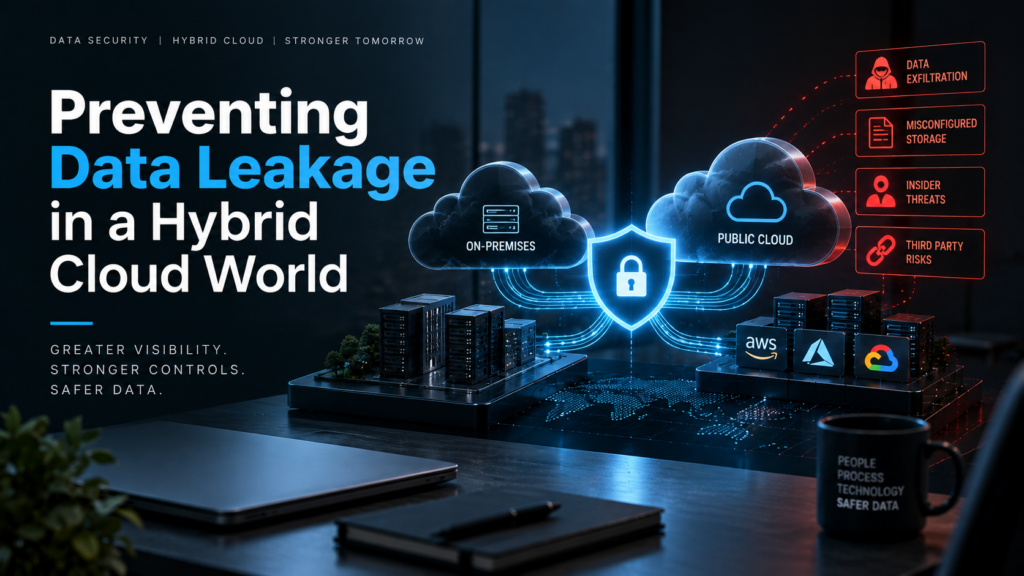
Data no longer sits in one place.
A business may keep customer records in a private data center, run applications in a public cloud, store backups with another provider, and allow employees to access everything remotely. APIs connect these environments, third party platforms exchange information, and employees move data between systems every day.
This flexibility is useful for business.
It also makes data leakage harder to control.
A sensitive file can leave a company’s environment without anyone breaking through a firewall. An employee may accidentally share the wrong document. A cloud storage bucket may be configured incorrectly. A stolen account may give an attacker access to sensitive information. A compromised application may expose data through an API.
In a hybrid cloud environment, the question is no longer simply, “Is our data secure?”
The better question is:
Where is our data, who can access it, where can it move, and what happens when something goes wrong?
At GLESEC, we approach data security with this wider view. Protecting sensitive information requires visibility across cloud and on-premises environments, controls that limit unauthorized data movement, continuous monitoring, and regular validation of the systems that handle critical information.
What Is a Hybrid Cloud Environment?
A hybrid cloud combines private infrastructure with public cloud services.
For example, a company may keep sensitive databases in its own data center while running customer-facing applications on a public cloud platform. Another organization may use a private cloud for internal systems while using public cloud services for analytics, collaboration, backups, or customer applications.
This setup gives businesses more flexibility.
They can place workloads where they make the most sense, scale services when needed, and use cloud platforms without moving every system away from existing infrastructure.
But it also creates more places where data can exist.
A single customer record may move between an application server, database, analytics platform, backup system, and third party service.
Every connection creates another opportunity for data to be exposed.
Why Data Leakage Is Harder to Control in Hybrid Cloud
Traditional security models often assumed that sensitive information stayed within a clearly defined corporate environment.
Hybrid clouds change that assumption.
Data can cross network boundaries, cloud accounts, applications, regions, and organizations. Employees can access systems from remote locations. Developers can create new cloud resources quickly. Business teams can adopt SaaS platforms without going through the same infrastructure process used for traditional systems.
The result is a security environment that changes constantly.
A security team may have strong controls around its private infrastructure while having limited visibility into data moving through cloud applications.
This creates gaps.
A system can be secure on its own while the connection between two systems introduces risk.
That is why hybrid cloud data security needs to consider the entire data flow, rather than protecting individual systems in isolation.
Data Leakage vs Data Breach
The terms data leakage and data breach are often used interchangeably, but they are not exactly the same.
A data breach generally involves unauthorized access to or disclosure of protected information.
Data leakage is broader.
It can include sensitive information being exposed, transferred, shared, or made accessible to someone who should not have it, whether the cause is malicious or accidental.
An employee sending a confidential file to the wrong person can cause data leakage.
A misconfigured cloud storage service can expose data.
A compromised account can allow an attacker to download sensitive records.
A developer can accidentally include credentials in a public code repository.
Not every incident starts with a sophisticated cyberattack.
Sometimes the problem is a simple mistake combined with too much access.
Where Data Leakage Happens in Hybrid Cloud
Understanding the common leakage points makes it easier to build the right controls.
Cloud Storage
Cloud storage is one of the most obvious areas to protect.
Sensitive files, databases, backups, and application data can be stored in cloud environments. If access permissions are too broad or a resource is accidentally exposed, information may become available to unauthorized users.
The risk becomes greater when organizations have multiple cloud accounts, subscriptions, storage services, and teams managing resources independently.
Regular access reviews and configuration checks can help identify unnecessary exposure.
APIs
APIs allow different applications and services to exchange data.
They are essential to modern systems, but they can also expose sensitive information when authentication, authorization, or data handling is poorly implemented.
An API may allow a user to access information that belongs to another account. It may return more data than the application needs. It may also allow sensitive actions without sufficient authorization checks.
Because hybrid environments depend heavily on integrations, API security should be treated as part of data protection rather than as a separate development concern.
Remote Access
Remote work has changed how employees access company systems.
Users may connect to cloud applications, internal resources, virtual desktops, and collaboration platforms from different networks and devices.
A compromised employee account can therefore provide access to data across multiple environments.
Strong identity controls, multi-factor authentication, least privilege, device security, and monitoring all play an important role in reducing this risk.
Third Party Services
Businesses rarely operate alone.
They share information with payment providers, analytics platforms, CRM systems, marketing platforms, suppliers, contractors, and other service providers.
Each integration creates another path for information to move.
Before sharing sensitive information with a third party, organizations should understand what data is being transferred, why it is required, who can access it, how long it is retained, and what security controls are in place.
A secure internal environment cannot fully protect data once it is transferred to a poorly managed external system.
The Biggest Risk Is Often Excessive Access
Not every person or application needs access to every piece of data.
Yet excessive permissions remain common in complex environments.
An employee may keep access after changing roles. A service account may have permissions that were originally granted for a temporary project. A third party application may have access to more information than it needs.
This creates unnecessary exposure.
The principle of least privilege provides a simple answer: give users and systems only the access required to perform their approved tasks.
That access should also be reviewed regularly.
Hybrid cloud environments make this more important because permissions can exist across different identity providers, cloud platforms, applications, databases, and internal systems.
Managing them as one connected access problem is much harder than reviewing a single corporate directory.
Data Loss Prevention Helps Control Sensitive Information
Organizations need controls that can recognize sensitive information and help prevent it from being moved or shared inappropriately.
This is where Data Loss Prevention (DLP) becomes valuable.
DLP policies can be designed to identify sensitive information and apply rules based on how that information is being used. Depending on the environment and implementation, controls can address actions such as copying, transferring, uploading, sharing, or sending protected information.
The exact policy should depend on the type of data and the business process involved.
A company may have different requirements for customer records, payment information, intellectual property, employee information, and confidential business documents.
GLESEC Data Leakage Prevention services are designed to help organizations protect sensitive information across cloud, on-premises, and remote environments while addressing both accidental and malicious data loss.
The goal is not to stop employees from using data.
The goal is to make sure sensitive information moves only through approved channels and under appropriate controls.
Visibility Comes Before Protection
You cannot protect data effectively if you do not know where it is going.
This sounds obvious, but hybrid cloud environments can make data mapping difficult.
Security teams should understand which systems store sensitive information, which applications access it, which APIs transfer it, and which external services receive it.
They should also know which assets are exposed to the internet.
This is where Attack Surface Management can support a broader data protection strategy.
External attack surface management helps organizations identify internet-facing assets and understand what is exposed outside the traditional network boundary. For a hybrid environment, this can include cloud services, applications, APIs, domains, and other externally reachable infrastructure.
Finding an unknown asset does not automatically mean it is vulnerable.
But an unknown asset cannot be properly assessed, monitored, or protected.
That makes visibility a basic requirement for reducing data leakage risk.
Protect Internet Facing Applications
Sensitive data is often accessed through applications.
A customer portal may retrieve personal information. An employee application may access internal records. An API may connect a public application to a private database.
If the application is compromised, the data behind it may be exposed.
This is why application security has a direct connection to data protection.
GLESEC Cloud Application Protection approach focuses on protecting internet-facing applications and APIs while monitoring for application-level threats, malicious activity, and other risks affecting cloud-facing systems.
For hybrid cloud environments, this type of protection can help secure the application layer where users, APIs, cloud services, and sensitive data meet.
The objective is not simply to protect the cloud infrastructure.
It is to protect the applications and connections through which business data is actually being accessed.
Test the Systems That Protect Your Data
Security controls should not be trusted simply because they exist.
They need to be tested.
An organization may have authentication, access controls, encryption, monitoring, and DLP policies in place while still having a vulnerability that allows an attacker to bypass those controls.
Security testing helps identify weaknesses before they become incidents.
GLESEC Continuous Penetration Testing approach helps organizations validate security controls and identify vulnerabilities across applications, networks, and other parts of the technology environment.
For hybrid cloud systems, testing should consider more than individual components.
The interaction between systems can create risks that are not visible when each component is tested separately.
A secure application connected to an insecure service can still create a security problem.
Monitor for Data Exfiltration
Stopping unauthorized access is important.
Detecting suspicious data movement is equally important.
Data exfiltration can happen after an attacker compromises an account, endpoint, application, or cloud resource.
Security teams should monitor for unusual downloads, unexpected transfers, abnormal API activity, suspicious cloud access, and other behavior that differs from normal business activity.
Context matters.
An employee downloading a large dataset may be completely legitimate if they are performing an approved task.
The same behavior from an account that normally accesses a few records may deserve investigation.
This is one reason centralized security visibility can be valuable.
GLESEC SKYWATCH OS provides a unified operational view of cybersecurity activity and risk, helping teams bring information from different security processes into a more connected workflow.
For hybrid environments, this broader view can help security teams connect exposure, suspicious activity, risk, and response instead of investigating every signal separately.
Encryption Is Important, But It Is Not Enough
Encryption remains a fundamental part of data protection.
Data should be protected while it is being transmitted and, where appropriate, while it is stored.
But encryption does not solve every data leakage problem.
If an attacker obtains valid credentials and accesses data through an authorized application, the data may be encrypted at rest while the attacker is accessing it normally.
Similarly, if an employee intentionally sends sensitive information to an unauthorized recipient, encryption alone may not prevent the action.
Data protection therefore needs several layers.
Encryption protects information from certain forms of unauthorized access.
Identity controls determine who can access systems.
Authorization determines what they can do.
DLP helps control how sensitive information is handled.
Monitoring helps identify suspicious activity.
Security testing helps expose weaknesses.
Each control addresses a different part of the problem.
Build a Hybrid Cloud Data Protection Strategy
A strong strategy starts with knowing what data matters most.
Not every piece of information requires the same level of protection.
Classify sensitive information based on business value, regulatory requirements, confidentiality, and potential impact if exposed.
Then map where that information is stored and how it moves.
Review access regularly and remove unnecessary permissions.
Monitor cloud resources and internet-facing applications.
Protect APIs and application interfaces that handle sensitive information.
Use DLP policies for sensitive data and test those policies to make sure they work as intended.
Review third party access and understand what information external services receive.
Finally, prepare for incidents before one occurs.
Your response plan should define who investigates suspected leakage, who can isolate accounts or systems, who communicates with customers and regulators when required, and how evidence will be preserved.
A fast response can significantly reduce the impact of an incident.
The Human Element Still Matters
Technology can reduce many data leakage risks, but employees remain an important part of the equation.
People make mistakes.
Someone can attach the wrong document to an email. A developer can accidentally expose a secret. An employee can approve a suspicious login request. A team can create a cloud resource without realizing that its configuration exposes sensitive information.
Security awareness therefore needs to accompany technical controls.
Employees should understand how sensitive information should be handled, which tools they are allowed to use, how suspicious activity should be reported, and why security policies exist.
The goal should not be to make employees afraid of using data.
It should be to make secure behavior the easiest behavior.
Hybrid Cloud Security Is a Continuous Process
Hybrid cloud environments will continue to change.
New applications will be deployed. Employees will join and leave. APIs will be added. Cloud resources will be created. Third party services will be connected. Old systems will remain in operation longer than expected.
This means data leakage prevention cannot be a one-time security project.
Organizations need continuous visibility into where sensitive data exists, who can access it, how it moves, and whether security controls are still working.
At GLESEC, we believe effective data protection requires this continuous approach.
Data Leakage Prevention helps control sensitive information across different environments. Attack Surface Management helps identify external exposure. Cloud Application Protection helps secure internet-facing applications and APIs. Continuous Penetration Testing helps validate defenses, while SKYWATCH OS brings security visibility and risk management into a connected operational view.
The individual controls matter.
But the connections between them matter just as much.
Protect the Data Wherever It Lives
The move to hybrid cloud has changed the boundaries of enterprise security.
Data can live in a private data center today and move to a cloud application tomorrow. It can pass through an API, reach a third party service, and return to an internal system without anyone physically moving a file.
That is the reality of modern business infrastructure.
The answer is not to stop using cloud services or restrict every movement of information.
The answer is to understand the data, control access, monitor movement, test security controls, and respond quickly when something goes wrong.
A strong hybrid cloud security strategy should answer five basic questions:
Where is our sensitive data?
Who can access it?
How can it move?
What controls protect it?
How quickly can we detect and respond to misuse?
If your security team can answer those questions with confidence, you have a much stronger foundation for preventing data leakage in a hybrid cloud world.
 NEWS POSTS